
 收藏本站
收藏本站
Learn about
 当前位置:
当前位置:Introduction to MP3
Introduction to MP3
Since 1998 the MP3 standard has become more and more important, and an enormous success. The potential is even bigger - personally I believe, that MP3 end up being as popular as the Compact Cassette did in the 20th century.
MP3 is a system to give a huge compression of digital sound files. The compression is lossy (i.e. musical details are cut away). Yet MP3 delivers a sound quality (almost) as good as uncompressed CDs, due to the very intelligent psycho-acustic algorithm reducing the file size.
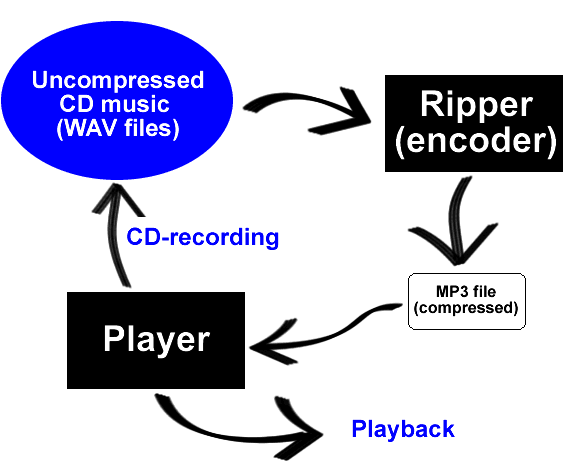
The MP3 format is very versatile; it can be hosted on any storage media and can be transferred on demand over the Internet. You use a ripper to encode MP3 files. These files can be played using a player like Winamp, MusicMatch or Windows Media Player. The MP3 files can also be decoded an used for CD-recording:
German research
MP3 means MPEG Audio Layer 3. It is an audio compression technology being a part of the MPEG-1 and MPEG-2 specifications. MP3 compresses CD quality sound by a factor of 8-12, while maintaining almost the same high-fidelity sound quality.MP3 is developed by a German research institute called Frauenhofer. The company Thomson Multimedia has patented MP3 in USA and in Germany.
Effective compressions
Music on CDs have a bandwidth of 1.4 Megabit per second. It is calculated as 2 X 16 X 44100 bit/sec. This mean that one minute of music on a CD takes up 10 MB of data.Using MP3 this bitstream is dramatically reduced (by factor 8 to 12). A typically MP3 file will need 128 per second. Hence one minute of music is reduced from 10 MB data to only 1 MB. Greater compression ratios are also possible for use on Internet etc. but here you will encounter a decrease in sound quality.
Standard MP3s hold approx. 1 minutes hi-fi music per megabyte.
This reduction is only possible using a set of compressions.
Lossy compression with psychoacustic algorithms
Overall we have to types of compression:
If we want compression without loss, we use systems like ZIP. This is very effective compression data files that hold plenty of redundant information. This could be Microsoft Word documents, they often zip very well. And when you unzip them, the document is identical to the original. You find similar compression within GIF and PNG graphics files, which compress many graphic images very well (but not photos).
However you do not find much redundant information in music files. A zip compression of raw music data (WAV files) may only yield 10% reduction in file size. Therefore we use a lossy encoding to reduce the music files sizes.
Lossy encoding mean that we take away music information (just as JPEG encoding take away image information from a photo). The goal is to remove music details you would not hear anyway!
Since MP3 offers variable compression you will find that the more you compress the music, more details are removed and lesser fidelity is the result.
Many ways to MP3
The MP3 standard tells what design a MP3 file should have. It does not tell how to produce the file. This indicates that we may experience quite different quality from different encoders.The most important principle in MP3 compression is the psychoacustic selection of sound signals to cut away. Those signals, we are unable to hear are removed. These include weaker sounds that are present but are not heard because they are drowned out (masked) by louder instruments/sounds.
Many encoders use the fact that the human ear is most sensitive to midrange sound frequencies (1 to 4 KHz). Hence sound data within this range is left unchanged.
An other compression used is to reduce the stereo signal into mono, when the sound waves are so deep, that the human ear cannot register the direction. Also the contents of common information in the two stereo channels is compressed.
The Huffman algorithm reduces the file size by optimizing the data code for the most often used signals. This is a lossless compression working within the MP3 system.
Pirating or legal
All over the Internet you find pirate copies of commercial music. This is not very good since it is illegal and may stop the development of the technology. At www.mp3.com you only find legal music, but there is lots of it!Napster
A great online music community was created around downloading and sharing MP3 files. This was Napster, and it was illegal. You cannot give away copies of your MP3s to anyone, unfortunately.Napster had to close down several times in 2000 and 2001 due to law suits from the music industry.
SDMI
Secure Digital Music Initiative. This standard was developed by Sony, EMI, and three other big companies.It is a security certification which can be used on MP3 files and other formats. It should help to prevent illegal copies of music. With SDMI a MP3 file can, as an example, be designed so it only can be copied three times.
SDMI is to built into MP3-players as Rio and MP3-man. Here it verifies the SDMI-sigature on MP3 files. However, the system allows replay of "illegal" MP3s as well.
上一篇:Sony product's package 2026-03-11
下一篇:The story of the fisrt chip/IC(Integrated Circuits) 2026-03-11


