
 收藏本站
收藏本站
Industrial
 当前位置:
当前位置:Stretchable wireless sensor promises to heal aneurysms
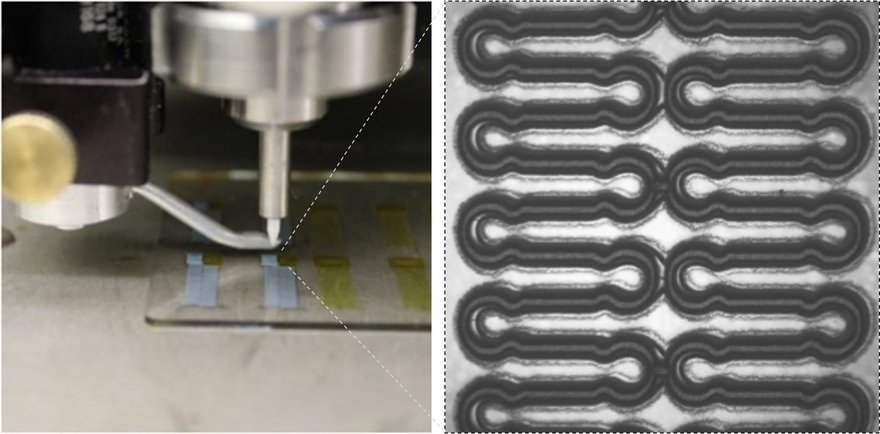
Georgia Tech researchers have developed a 3D printed, stretchable wireless sensor that is implanted in the human brain to treat cerebral aneurysms. (Georgia Tech)
Georgia Tech researchers are developing a tiny, stretchable wireless sensor that is implantable in the blood vessels of the human brain. The sensor could help clinicians evaluate the healing of aneurysms—bulges that can cause death or serious injury if they burst.
The battery-free stretchable sensor is designed to be wrapped around stents or diverters implanted to control blood flow in vessels affected by the aneurysms. It is inserted using a catheter system and uses inductive signal coupling to allow wireless detection of biomimetic cerebral aneurysm hemodynamics. Currently, monitoring the progress of cerebral aneurysms requires repeated angiogram imaging using contrast materials, that can have harmful side effects.
The sensors are fabricated through a 3D printing technique to create conductive silver traces on elastomeric substrates. According to the researchers, the use of additive manufacturing allows very small electronic features to be produced in a single step, without using multi-step lithography.
"The beauty of our sensor is that it can be seamlessly integrated>"For patients who have had a procedure done, we would be able to tell if the aneurysm is occluding as it should without using any imaging tools," Yeo said. "We will be able to accurately measure blood flow to detect changes as small as 0.05 meters per second."
The six-layer sensor is fabricated from biocompatible polyimide, two separate layers of a mesh pattern produced from silver nanoparticles, a dielectric and soft polymer-encapsulating material. It includes a coil to pick up electromagnetic energy transmitted from another coil located outside the body. Blood flowing through the implanted sensor changes its capacitance, which alters the signals passing through the sensor>In the laboratory, Yeo’s team have measured capacitance changes six centimeters away from a sensor implanted in meat to simulate brain tissue.
"The flow rate is correlated really well with the capacitance change that we can measure," Yeo said. "We have made the sensor very thin and deformable so it can respond to small changes in blood flow."
The next phase of the aneurysm sensor will be able to measure blood pressure in the vessel along with the flow rates. "We will be able to measure how pressure contributes to flow change," Yeo explained. "That would allow the device to be used for other applications, such as intracranial pressure measurements."
@Spencer Chin
上一篇:thirteen sensors hidden in the smartphone 2026-05-14
下一篇:Should the sensor industry develop with reference to the chip industry? 2026-05-14


